All courses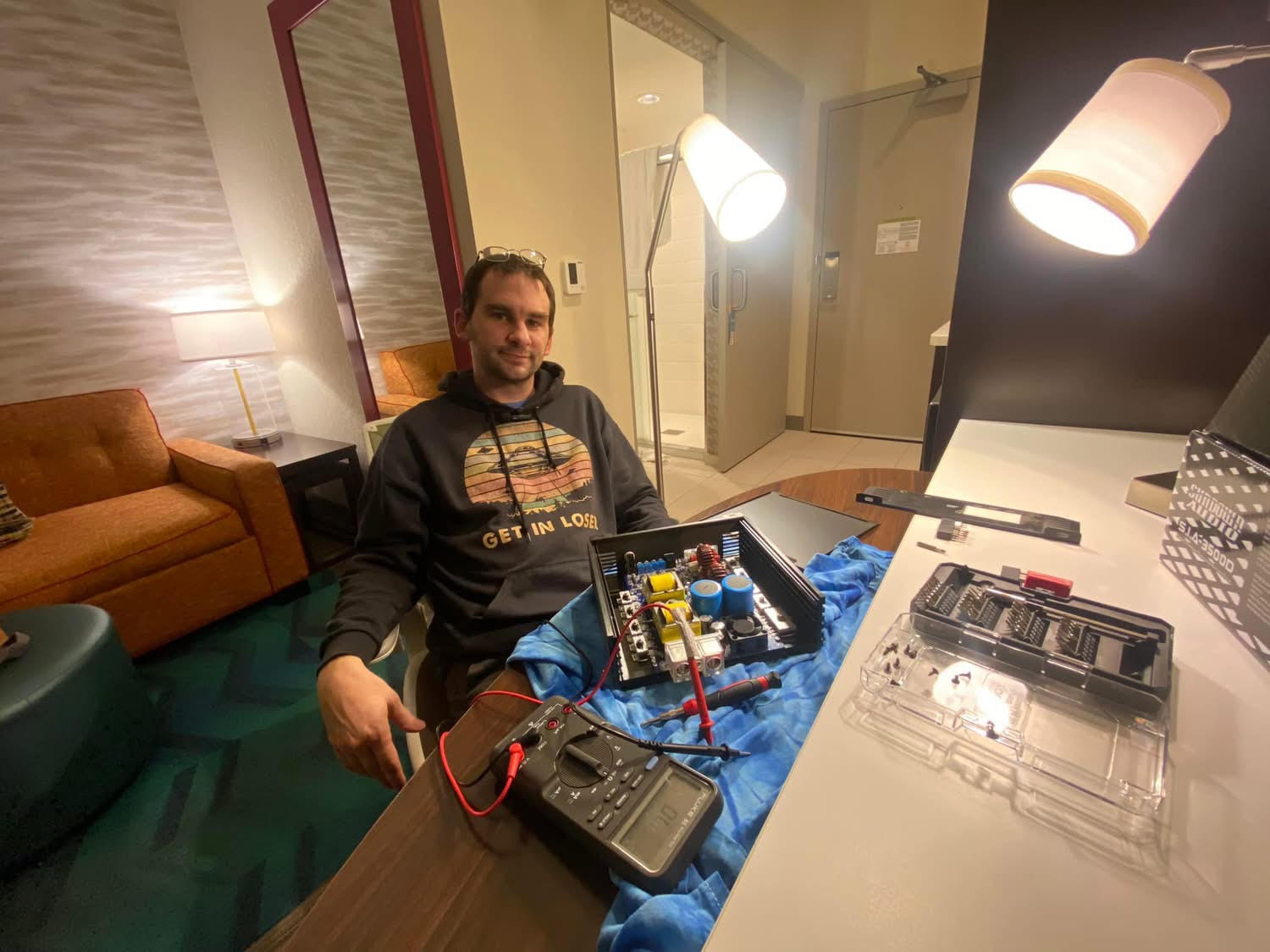 InstructorJacob Calhoun
EET 210
Term 4
4 credits
Analog Circuit Design
Design with operational amplifiers: gain stages, active filters, oscillators, and instrumentation amplifiers. Includes noise analysis and stability in practical circuits.
InstructorJacob CalhounPrerequisites
Course outline
Lectures, virtual labs, and graded assignments — completed in your browser.
01Op-amp fundamentals and ideal modellecture
02Inverting and non-inverting configurationslab
03Summing, difference, and instrumentation amplifierslab
04Real op-amp limits: offset, bias, slew rate, GBWlecture
05Comparators, hysteresis, and Schmitt triggerslab
06Active low-pass and high-pass filterslab
07Band-pass, notch, and multi-stage filter designassignment
08Midterm examassignment
09Oscillators: RC, Wien bridge, relaxationlab
10Precision rectifiers, integrators, differentiatorslab
11Noise sources, bandwidth, and signal integritylecture
12Sensor front ends and signal conditioninglab
13Voltage references and linear regulatorslecture
14Analog design project and final examassignment
Syllabus
# Analog Circuit Design (EET 210)

**Credits:** 4  |  **Term:** 4  |  **Contact hours:** 3 lecture / 2 virtual lab hours per week
**Prerequisites:** EET 201 Semiconductor Devices
**Delivery:** Fully online. Lectures on demand, weekly live office hours, and browser-based virtual labs with simulated instruments.

## Course description
Op-amps, filters, oscillators, instrumentation amplifiers, noise. This 14-week course develops practical competence in analog circuit design through weekly lectures, virtual lab exercises, and graded assignments.

## Learning outcomes
On completion of this course the student will be able to:
1. Explain the core principles and vocabulary of analog circuit design.
2. Perform the analysis, calculations, and procedures introduced each week.
3. Use virtual instruments and software tools to build, measure, and verify results.
4. Diagnose faults and explain discrepancies between predicted and measured behavior.
5. Document work clearly in lab reports that meet industry documentation standards.

## Weekly schedule
Fourteen weekly modules are listed under Lessons, each pairing a lecture with a virtual lab or assignment and a short knowledge check.

## Grading
- Virtual lab work and reports: 35%
- Weekly assignments and quizzes: 20%
- Midterm exam or practical: 20%
- Final exam or project: 25%

Grade scale: A 90-100, B 80-89, C 70-79, D 60-69, F below 60. A grade of C or higher is required to advance to any course that lists this one as a prerequisite.

## Course policies
- Weekly work is due Sunday at 11:59 PM local time; late work loses 10% per day up to five days.
- All submitted work must be your own; simulation files are individually seeded and checked.
- Students needing accommodations or an extension should contact the instructor through the portal before the due date.
- Instructors reply to portal messages within one business day.